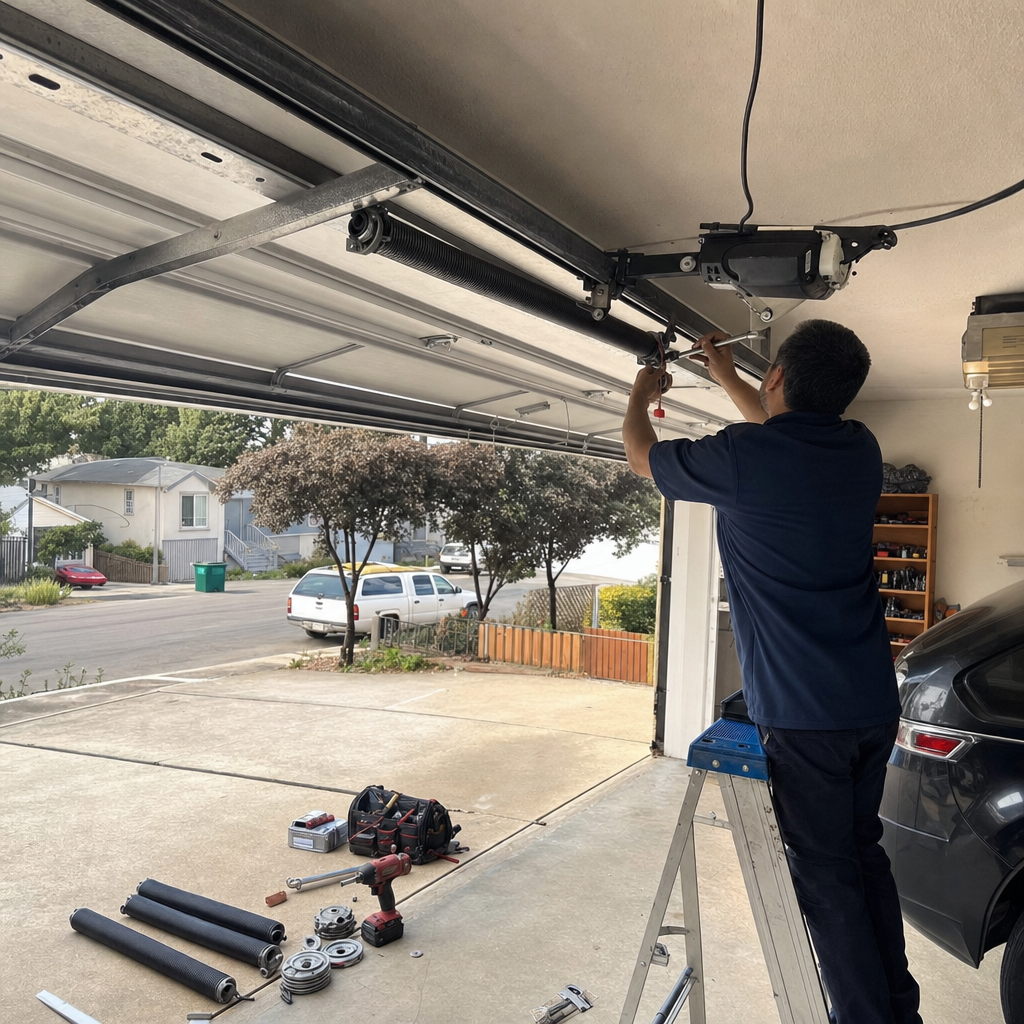
Fast, Reliable Garage Door Parts Across Castro Valley
Garage door parts in Castro Valley typically cost $110–$340 depending on the component, and most replacements are completed in a single visit with the correct hardware on the truck. Because Castro Valley’s hillside properties, detached workshops, and low-headroom ranch garages demand heavier-duty springs, calibrated cables, and grade-specific track hardware, you need a technician who shows up with parts sized for your actual door—not generic off-the-shelf pieces that bind or fail early.
We’re Legacy Garage Door Service San Francisco, and Paul Torres handles every Castro Valley call personally. From the older tract homes near Lake Chabot to the acreage properties off Crow Canyon Road and the Palomares Hills, we’ve learned what breaks here and why. That hillside terrain means more weight, more strain, and more corrosion than the flatland cities nearby. When your torsion spring snaps at 6 a.m. or your cable frays on a Sunday, waiting two days for a parts order isn’t workable. Paul carries the inventory to fix it in one trip. Call (833) 700-7382 for a free estimate.
Why Legacy Garage Door Service San Francisco Is Castro Valley’s Preferred Garage Door Parts Company
Owner-level accountability on every job. Paul Torres is the owner and the lead technician. When you call, you talk to Paul. When he arrives at your Castro Valley home, he’s the one diagnosing the problem, selecting the parts, and installing them. No subcontractors. No rotating crews. That matters on hillside jobs where a miscounted spring turn or the wrong cable drum means a second trip you shouldn’t have to pay for.
Nearly 1,000 verified reviews back the work. Our 935 customer reviews averaging 4.7 stars include homeowners from across Alameda County who needed parts replaced correctly the first time. Castro Valley customers specifically mention the one-trip completion and the willingness to explain why a heavier spring or upgraded roller was necessary for their slope or door weight.
We know the local conditions that kill parts early. The marine-layer fog that pools in Castro Valley’s bowl geography rusts torsion springs and bottom brackets faster than manufacturer estimates predict. The 1950s–1970s ranch and split-level stock with low-headroom garages requires track hardware that big-box stores don’t stock. And because Castro Valley is unincorporated Alameda County, permit requests for new openers go through the county building department—a process that catches homeowners and newer contractors off guard. We’ve navigated it repeatedly.
Whatever brand you have, we stock for it. Eight years specializing exclusively in garage doors means we’ve built relationships with suppliers who can source same-day or next-day for LiftMaster, Craftsman, Raynor, and Wayne Dalton systems common in Castro Valley homes. When your door won’t wait, neither do we.
Our Garage Door Parts Services in Castro Valley
Torsion Spring Replacement
Torsion springs are the workhorse of most Castro Valley garage doors, and they’re also the part that fails most dramatically. On hillside properties with heavy insulated steel doors or oversized workshop openings, the spring must be calibrated for both door weight and the extra strain of high-lift or vertical-track configurations. We replaced a heavy 16×7 steel insulated door on a detached workshop on Crow Canyon Road. The original opener was a 1/2 HP chain-drive that struggled with the extra weight and high-lift track needed for the sloped driveway. We upgraded to a LiftMaster 3/4 HP with a torsion spring system calibrated for the grade and the door’s insulated R-value. A standard spring rated for 10,000 cycles in flatland Hayward might last only 7,000 cycles on a Castro Valley slope. Paul sizes springs for your actual conditions, not a generic chart.
Safety note: Torsion springs store massive mechanical energy. A broken spring or a DIY replacement attempt can cause serious injury. This work requires specialized winding bars and training—call a professional.
Extension Spring Systems
Extension springs still appear on some older Castro Valley single-car garages, particularly in the 94546 zip code’s original 1950s tract homes with lightweight wooden doors. These springs stretch and contract along the horizontal track, and they’re more exposed to the damp morning fog that rolls in from San Francisco Bay. That moisture accelerates coil corrosion and increases the risk of sudden failure. When we replace extension springs in Castro Valley, we typically upgrade to a torsion system if the header and headroom allow—it handles weight more smoothly and lasts longer on sloped driveways where door balance shifts under load.
Cables & Drums
Cable failure in Castro Valley usually traces to two causes: corrosion from persistent dampness, or improper drum selection for hillside track geometry. The valley’s bowl geography funnels marine-layer fog and moisture in from the Bay most mornings, creating persistently damp conditions on springs, cables, and bottom brackets that accelerate corrosion faster than the drier Tri-Valley cities just over the hills to the east. This makes spring and cable replacement intervals notably shorter than manufacturers’ general estimates, and it’s a recurring conversation with homeowners who are surprised by how quickly hardware rusts. Standard cable drums are designed for level thresholds. On sloped driveways common from Palomares Hills to the upper reaches of 94552, the door’s low point and high point shift during travel, binding cables against flanges or causing uneven wrap. Paul carries multiple drum profiles and sizes cables to the inch for your specific track angle.
Rollers & Hinges
Nylon rollers with sealed bearings outperform steel rollers in Castro Valley’s damp climate—they don’t rust and they run quieter, which matters when your bedroom sits above or beside the garage. Hinges take abuse on heavy doors and sloped tracks where panel alignment shifts under weight. On low-headroom ranch garages, the tight track radius puts extra lateral force on the center hinge and top roller. We stock heavy-duty 14-gauge hinges and 6200-series sealed bearing rollers rated for the actual door weight, not the nominal capacity.
Weatherstripping & Bottom Seal
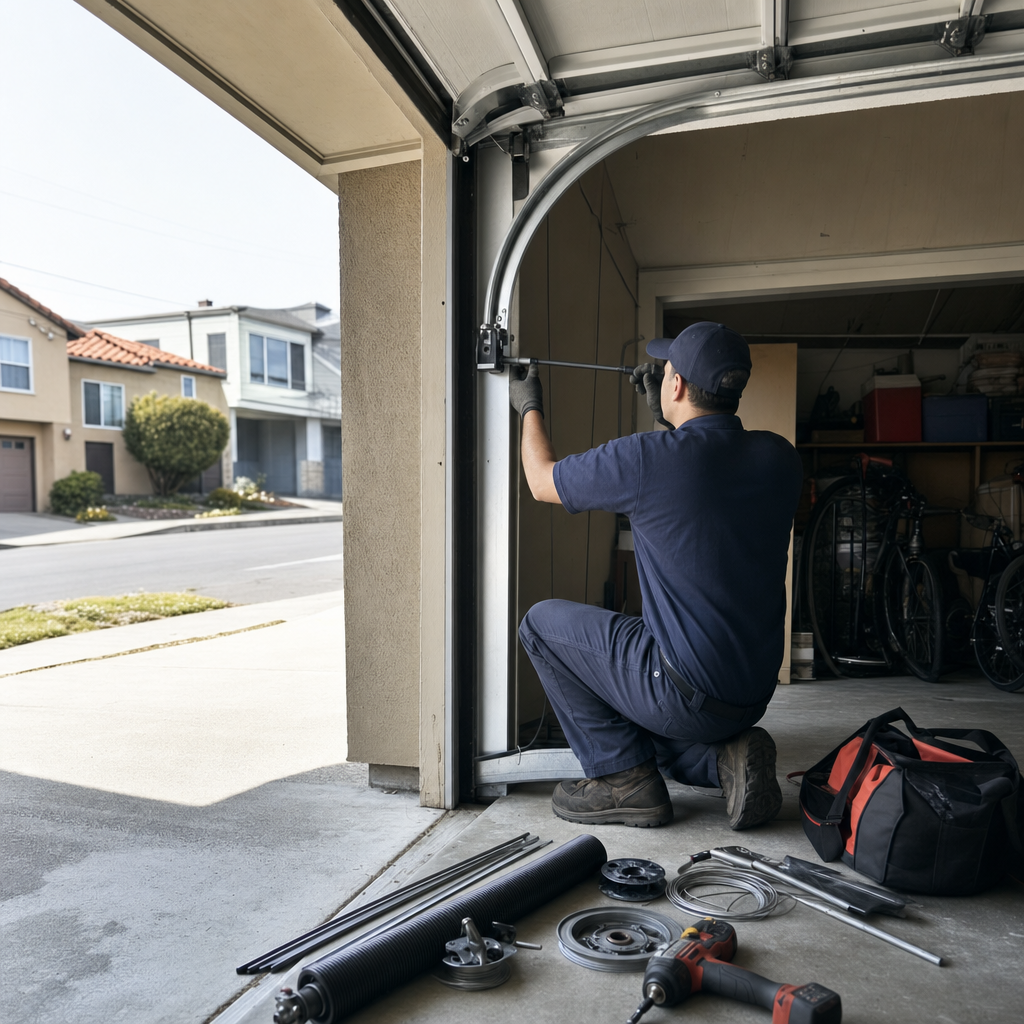
Castro Valley’s damp microclimate makes bottom seal and jamb weatherstripping a maintenance item, not a set-it-and-forget-it installation. The rubber or vinyl that seals against driveway splash and morning fog hardens and cracks faster here than in drier inland cities. For sloped driveways, we specify bulb-style or oversized bottom seals that maintain contact across the grade variation—standard T-style seals gap at the high or low end and let water and rodents in. We also check the retainer channel, which corrodes and prevents proper seal seating.
What happens when you call
- 1
A real person answersNo phone trees — you reach a local pro.
- 2
You get an upfront price rangeHonest numbers before anyone is dispatched.
- 3
A background-checked tech heads outLicensed & insured, dispatched right away.
- 4
You approve before work beginsNothing starts until you say go.
Trusted Brands We Service in Castro Valley
We maintain parts inventory and supplier relationships for eight major garage door brands: LiftMaster, Chamberlain, Genie, Clopay, Amarr, Wayne Dalton, Craftsman, and Raynor. In Castro Valley, we see a lot of older Craftsman chain-drive openers in the original tract homes and Wayne Dalton torquemaster systems in 1980s–90s builds. LiftMaster belt-drive and jackshaft units are popular upgrades for the heavy insulated doors going into hillside workshops and modern renovations. Because we specialize exclusively in garage doors—not general handyman work—we don’t waste time guessing at part numbers or compatibility. Paul knows which Wayne Dalton spring converter kit fits which door vintage, which Raynor cable drum matches which track geometry, and which LiftMaster rail extension you need for an 8-foot door on a high-lift application. That fluency means faster repairs and fewer return trips.
Common Garage Door Parts Problems We See in Castro Valley Homes
- Rusted torsion springs failing in 2–3 years instead of 7–10. The marine-layer moisture that lingers in Castro Valley’s valley bowl corrodes spring wire from the inside out. Homeowners are often surprised by early failure until we show them the rust bloom on the stationary cone and the pitting on the wire surface.
- Low-headroom track binding in ranch-style garages. The 1950s–1970s housing stock with attached, low-headroom garages was built for lightweight wooden doors. Modern steel or insulated panels add 30–50 pounds, and the tight track radius forces rollers against the hinges. Standard quick-fix roller swaps don’t solve it—the track geometry itself needs evaluation.
- Aging wooden doors warping out of their original narrow openings. Many Castro Valley homes still have the original single-car or undersized double-car openings with aging torsion springs and tracks that were spec’d for the lighter wooden doors of that era, making modern steel or insulated panel swaps a more involved retrofit than a straight replacement. The jambs are often out of plumb, and the header needs reinforcement before new hardware will operate smoothly.
- Permit delays on opener replacements catching homeowners off guard. Because Castro Valley is unincorporated Alameda County—not a city—garage door opener permits and electrical inspection requests go through the Alameda County Building Department rather than any city hall, which routinely catches homeowners and even newer contractors off guard and adds unexpected scheduling lag on jobs that require pulling a permit for a new dedicated circuit. We flag this upfront and handle the paperwork when needed.
Pricing for Garage Door Parts in Castro Valley, CA
Here’s what typical parts replacement costs in Castro Valley, calibrated for the heavier hardware and slope-specific components this market demands:
| Service | Price Range |
|---|---|
| Spring Repair | $180–$340 |
| Cable Repair | $130–$250 |
| Roller Replacement | $110–$220 |
These ranges cover the part, labor, and the diagnostic work to confirm what actually failed—not just the symptom. A snapped cable often reveals a worn drum or imbalanced spring. A noisy roller may indicate a bent track from years of operating on a slope. Paul assesses the full system so you’re not replacing the same part again in six months.
Factors that push toward the higher end: heavy insulated doors requiring higher-cycle springs, sloped-driveway track modifications, low-headroom conversions, and corrosion damage to multiple components. We provide upfront pricing before any work begins. Estimates are free—call (833) 700-7382.
We Also Serve Cities Near Castro Valley
We carry parts inventory sized for the same hillside and flatland conditions across Alameda County. If you’re in Cherryland, Fairview, Hayward, or Ashland, Paul covers your area with the same one-trip standard and the same direct accountability. Our Garage Door Parts team stocks hardware for the full range of East Bay door weights, track configurations, and microclimates.
Serving Castro Valley, CA — Our Local Coverage Area
We’re based in the Castro Valley area and know this community well. Use the map below to see our service coverage — if you’re nearby, we can almost certainly help.
FAQs — Garage Door Parts in Castro Valley
Yes, and it goes through Alameda County Building Department, not a city hall, because Castro Valley is unincorporated. This surprises many homeowners and can add several days to the timeline if you don’t plan for it. We handle the permit application as part of the installation process when a new dedicated circuit is required. Call (833) 700-7382 and we’ll walk you through whether your specific job needs one.
The valley’s bowl geography traps marine-layer fog and moisture against hardware, accelerating corrosion faster than manufacturer estimates predict. Springs that should last 7–10 years often show significant rust in 2–3 years here. We use galvanized or coated springs when available and recommend annual lubrication with a silicone-based product, not WD-40, which attracts dust and traps moisture. Call (833) 700-7382 for a spring inspection.
Usually yes, but it requires more than a straight swap. The heavier steel door needs a stronger spring system, and the low headroom common in Castro Valley ranch homes demands a specialized track configuration—either a dual-track low-headroom kit or a wall-mounted jackshaft opener that eliminates the rail entirely. Paul evaluates the header, side room, and headroom on every retrofit. Call (833) 700-7382 for an in-person assessment.
Most heavy insulated 16×7 doors on sloped driveways need at least a 3/4 HP opener with a belt or chain drive rated for the weight, not the 1/2 HP units common in older homes. The high-lift or vertical track configuration on steep grades adds friction and load. For very heavy doors or frequent cycling, we often recommend a LiftMaster 3/4 HP or equivalent with battery backup and soft-start programming to reduce strain on the entire system. Call (833) 700-7382 for a sizing recommendation.
In Castro Valley’s damp climate, inspect bottom seal annually and expect replacement every 2–3 years—sooner if you park on a sloped driveway where water pools against the high side of the seal. Hardened, cracked, or gapped seal lets in moisture that corrodes tracks and bottom brackets. We stock oversized and bulb-style seals that maintain contact across grade variations. Call (833) 700-7382 for a free seal check with any service call.
Written by Paul Torres, Owner at Legacy Garage Door Service San Francisco, serving Castro Valley since 2016.